Four hundred ninety-nine pages detail that fall. That’s just the executive summary; the government won’t let you read some six thousand five hundred pages more for fear you might use them to start a fire to burn down Washington.
United States Senator John McCain — whose body and mind was forged in torture in Vietnam — said CIA torture interrogations “actually damaged our security interests, as well as our reputation as a force for good in the world.”
“It’s about us,” he said, “what we were, what we are, and what we should be, and that’s a nation that does not engage in these kinds of violations of the fundamental basic human rights that we guaranteed when we declared our independence.”
These were the key findings:
Torture doesn’t work.
The CIA used torture because it mistakenly believed torture does work.
The torture was far worse than the CIA let on.
Conditions of confinement were worse than the CIA told policymakers.
The CIA lied to the Department of Justice so it couldn’t properly analyze the torture program.
The CIA would rather not be supervised by Congress.
The CIA would rather not be supervised by the White House.
The CIA would rather not cooperate with the FBI, the State Department, or the Office of the Director of National Intelligence.
The CIA would rather not be supervised by its own Office of Inspector General.
The CIA told lies to the media about what it was doing, but that was okay because they were telling the same lies to Congress, the Department of Justice, and the President..
The CIA didn’t know what to do with the suspected terrorists it captured, and had no plan to ever turn them loose if it discovered it was wrong.
The CIA put people in charge of torture interrogations who had no idea what they were doing.
The CIA torture interrogation program was designed by two Air Force guys who had no experience in interrogation, had barely heard of al-Qa’ida, and whose knowledge of the language and culture was confined basically to belly dancers.
CIA detainees were tortured by means not only unapproved by the Department of Justice, but unauthorized by the CIA.
The CIA was never sure just how many people it detained, why they were detained, or what happened to them.
The CIA never tried to find out if torture was actually working.
The CIA rarely reprimanded or in any way held accountable torturers who might have gone a little over the top.
Criticisms, critiques, and objections about the torture interrogations, even from within the CIA, were like water running off a duck.
The CIA torture interrogation program essentially collapsed under its own weight when other countries tired of hosting torture sites and started blabbing about it. All but one country, whose name is still classified (but you probably wouldn’t want to live there), bailed on the program.
The CIA torture program damaged U.S. standing in the world, created tensions with U.S. partners and allies, and screwed up bilateral intelligence relationships.
[Editor’s Note: Kit Johnson is a primary contributor to the ImmigrationProf Blog. At the beginning of this month, she spent a week assisting immigrant families awaiting deportation hearings at the Artesia detention facility in remote southeast New Mexico. Open only since June, it is already closing down, and families are being transferred to a massive and barren dirt enclave in Dilley, Texas, by month’s end. The center was sued by immigration and civil rights groups who called it a deportation mill that routinely violated detainees’ constitutional rights. One of those detainees, an eleven-year-old boy, turned out to be an American citizen. Professor Johnson has kindly consented to share this look at what these families leave behind.]
LIVE FROM ARTESIA
Day One
I arrived in town just before sunset. The radio was playing The Eagles’ Hotel California – I kid you not.
I spent the evening getting a very intense orientation from the wonderful on-the-ground (OTG) team here in Artesia. I was particularly pleased to hear the soothing and familiar voice of immigration professor Stephen Manning – welcoming us to the OTG team in an innovation lab video, naturally, with psych-up background music.
I have two bond hearings and two continuances to prep for tonight and tomorrow morning. And I expect to meet with additional clients about their bond cases. The American Immigration Lawyers Association (AILA) is trying to secure bond for as many of the Artesia detainees as possible – all of whom are hoping to avoid transfer to Karnes. [Editor’s Note: Karnes County Civil Detention Center in Texas is the site of alleged sexual assault by guards of immigrant mothers, sometimes in front of their children.]
Day Two, Morning
Today was my first visit to FLETC – the Federal Law Enforcement Training Center that is the Artesia detention facility.
I arrived at 7:00 a.m. to meet with three clients about what would happen in court that morning. Of course, nothing that we prepared for actually happened. All three cases were continued to later in the week.
I’d heard stories about the surreality of immigration court in Artesia. It was, indeed, surreal. The clients and attorneys sat in front of a large video screen where they interfaced with an extremely pixilated immigration judge (IJ) in Denver.
The clients’ kids and other families waited in the background – trying, sometimes in vain, to remain quiet.
While the cases today were all bond hearings or continuances of the same, and so less sensitive than merits hearings, it still felt wrong to have the kids in the room.
One adorable young boy, about 3, kept running up to his mom and trying to catch her attention during her bond hearing. I ended up sneaking him off to a corner to try to keep him amused with the few entertainments in the room. He scribbled on a paper airplane and flew said airplane around the “courtroom.” He also played with a small dixie cup and a little yellow plastic figurine that looked like a game piece from Candyland.
Another boy, about 5, was disturbing in his quiet. He sat perfectly still, silently watching the somewhat rambunctious 3 year old’s antics.
Day Two, Afternoon
There is a client consultation trailer at the Artesia detention facility. It is split into different zones.
Along one edge of the trailer there is a narrow “lawyers-only” corridor. It runs the length of the trailer and is perhaps 5 feet wide.
There’s a table near the entrance to the lawyer’s corridor where U.S. Immigration and Customs Enforcement (ICE) agents sit. These are the guys who bring clients to the trailer. They also escort lawyers to and from their cars and to the restrooms. (We are dangerous folk who cannot walk around unaccompanied.) These guys are by and large incredibly friendly – to us, the women, and especially the kids.
The trailer also has five modular “offices” for meeting with clients. Each has sliding semi-opaque doors and walls that don’t reach to the ceiling. It therefore has neither the appearance of privacy nor actual privacy.
The rest of the trailer is essentially a waiting area. There are eight tables each with four chairs. There’s a brightly colored oval right in front of a TV that is always playing a children’s movie – sometimes in Spanish, sometimes in English. (I can now tell you the entire plot of Ice Age: The Meltdown. Be jealous.)
I spent the afternoon in the trailer meeting with clients. I saw six different women and, for the most part, spoke with them about their upcoming bond hearings. Some were stoic. Some were weepy. Some were sick. All were tired of being in detention. All prayed to God that their bond hearings would be granted.
I can’t sign off without noting what was, for me, the biggest surprise of the afternoon. I walked into the ladies’ bathroom and found a volunteer barber cutting kids’ hair. The boys all seemed to be sporting identical buzz cuts. But a little girl, maybe 7 or 8, was getting a careful trim of her very long locks. She looked so happy to be sitting in that chair, having her hair so carefully combed and trimmed.
Day Three, Morning
This morning’s docket was much busier than yesterday. In addition to hearing continuances, Denver Immigration Judge Donn Livingston held five substantive bond hearings. All resulted in grants – but at vastly differing sums from $7500 to $2000. He seemed particularly concerned about: (1) whether the respondents used a coyote to gain entry to the U.S., how much they paid said coyote, and how many people joined them on the journey; as well as (2) whether the respondents had strong family ties in the US.
For the second day in a row there was a rambunctious six-year old boy present who wanted to bother his mom while she was being questioned by the judge. I managed to entice him away by appropriating some paper and making cootie-catchers for him. And paper airplanes. But this kid straight up schooled me on the proper way to fold an airplane. My sons will be thrilled when I come home with new knowledge.
The absolute highlight of my day was seeing the huge smiles on the faces of one mother and son who got bond today. The son was about 2 and when I told him he was guapo y adorable, he just nodded with a big grin on his face. He also gave me two very big hugs, the sweetie!
Day Four, “Everyone Cries in Artesia”
I’d heard that everyone cries in Artesia. At some point, I was told, everyone hits a wall and breaks down.
I don’t know that I really believed that until today.
This morning I was covering IJ Livingston’s docket with the lovely Julie Braker (more on her in another post). Julie was holding a bond hearing for an indigenous-speaking client. This client had a son, a little over two years old, who started acting up and demanding his mother’s attention. So I picked him up and rocked him in the back of the courtroom. But then, this boy decided that wasn’t what he really wanted. He started to really fuss and cry for his mom. So I left the courtroom with him in my arms.
I spent the duration of the hearing (20 minutes? 30? 45?) outside with an inconsolable toddler. I say toddler, but this kid was so small. He was about the size of a 10 month old.
And all this kid wanted was mom – to nurse, I think. I tried singing to him, rocking, bouncing, distracting him with trucks and planes, all of my mom tricks. Nothing worked. Well, the plane thing worked for the 10 seconds he could see the plane in the sky. But then it was back to crying for mama.
I was outside with an ICE agent. This fellow valiantly tried to help as well. He played soothing baby music on his phone. He performed magic tricks with a quarter. He blew bubbles with his gum. He even tried to get me a pacifier but wasn’t allowed to requisition one from the warehouse. We were given an empty bottle but, 30 seconds after finally getting this, mom returned.
At which point I had to literally run back to court to cover a bond hearing.
I don’t know why this child’s anguish has affected me as much as it has. I think it’s that he genuinely thought he might never see his mom again. And the horror of not being able to get him a pacifier just killed me. And then I think about his mom, who while trying to testify on behalf of her bond application, to get herself and her sons out of detention – she had to listen to her son’s wailing.
It’s a few hours later and I’m still shaky and overwhelmed.
Day Five – Laughter Amid Tears
Today wasn’t a tear-free day. I prepped one woman for her bond hearing tomorrow and just welled up with tears reading her credible fear determination (of persecution or torture if deported to the home country). This woman has suffered the most horrendous acts of domestic violence. I had to stop and try to compose myself. And, of course, my near-tears caused her near-tears. It was tough.
.
But I want to tell you not about the tears, but the laughter. Because today, I laughed.
First, I want to tell you about a kid who I’ll call Arturo. Arturo is three or four years old. He came to his mom’s bond hearing this morning. And since I was covering the docket by myself, there was no one I could pass him off to when he started to get a little antsy with the proceedings. I just kept my eyes on the video camera, tore off a few pages from my notebook, and handed him a pen so he could color. But here’s the thing. At some point the IJ was looking a few things up on his computer and everyone was silent. Arturo climbed into his mom’s lap for what looked like a snuggle. Instead, he used the vantage point of her lap to lean over, right over the microphone, and whisper “Hola.” It was the damndest thing. I couldn’t laugh out loud in the middle of court, but I had a hard time keeping a straight face when I told him not to do that again.
And now a tale about a kid whom I’ll call Isabel. Isabel is not yet three. She is a teensy tiny little thing. And she showed up to her mom’s bond prep with me this afternoon wearing this bright teal sweatshirt with a raccoon on it that inexplicably said “Hug Me.” Miss Isabel was so well behaved that I was able to have a great strategy session with her mom. At one point, I got excited, slapped my hand on the table and pointed at the mom to say something along the lines of “That’s it!” Before I knew it, Isabel did the exact same thing. She slapped her hand to the table and pointed right at me. I laughed with explosive, gigantic cackles.
It’s amazing that kids can continue to bring such spontaneity and joy here amidst the chaos, uncertainty, monotony (please, God, no more Frozen on the TV tomorrow), and fear.
Day Six – The Last Hearings
Today I had my final hearings in front of IJ Livingston.
While in court I, yet again, needed to help a fellow AILA pro bono attorney (this time the wonderful Megan Jordi – more on her later) with a disruptive toddler. I had the unenviable task of actually peeling a 2 year old off his mother and forcibly removing him from court.
I spent the next (20? 30? 45?) minutes with another inconsolable toddler. I again tried to distract him with construction equipment, planes, anything. This time, I had not just one but three other ICE agents trying to help me calm this child down. One brought a sucker. Another brought a toy. Another (clearly a supervisor) asked if I needed milk or juice or anything else that he might be able to provide. But nothing really calmed him down. I bought a few precious moments by pointing to things (a bulldozer) and asking him to tell me what the word in Spanish is to describe it. But, again, all he wanted was mama.
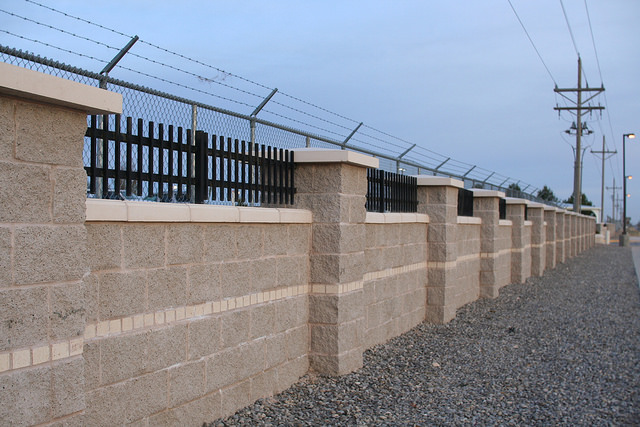
The upside of handling an inconsolable toddler is that you’re allowed to walk wherever you feel like it to calm the kid down. So I was able to see the other parts of our complex that I might not otherwise see. I was able to discern that we were in a small segment of the FLETC campus that was blocked off by chain link fencing with interwoven wood slats. It is about 3 trailers by 2 trailers. So it was just a small part of the bigger facility – one kept locked away and isolated.
One of the places I got to see was a dayroom. Like the attorney trailer, this room had a brightly colored rug. It also had a couch in front of a TV that appeared to have some sort of gaming system attached. There weren’t tables and chairs like in the consult room. Instead, the rest of the room is more or less open. There’s a table where the ICE officers sit (b/c nothing says “Hey, relax in the dayroom” like constant supervision). There was one of those foot-powered plastic trucks for toddlers to sit in and drive. And there was a pack-n-play occupied by an infant.
Eventually mom finished her testimony and I was able to reunite her with her son – at which point I headed back into my own bond hearings.
I had three bond hearings today. All the women bonded out. One at $2000, one at $5000, and another at $2500.
The $5000 bond was set in a case that I knew would be difficult. The client had paid a coyote a substantial sum of money and she wasn’t going to be staying with close relatives in the U.S. – two of IJ Livingston’s big concerns. But she had a rock solid asylum case based on DV with a horrendous and documented/documentable history. Unfortunately, the client’s case just didn’t present in court as well as it had in prep. I had prepared the client that I was going to talk about her substantive claims and even arranged for Megan to take her young son out of the courtroom during her testimony. But the IJ shut down any questioning along these lines. So I was pretty disappointed in the outcome, although I hold out hope that she’ll be able to bond out at that high amount in any event.
The $2500 bond was set in my last case of the day – indeed, my last case in Artesia. Just before the IJ announced the bond in Spanish to my client, her 7-year-old son started to cry. I think he thought they had been denied or that something bad had happened. While his mom was comforting him, the judge told her (through the translator) that her bond had been granted. She just broke down crying and told her son over and over “We’re leaving! We’re leaving!” At this point, I completely lost control. I started to cry. On the record. In front of the IJ. I just cried. I grabbed some tissues and tried to compose myself, but I wasn’t very composed. I eked out a motion to withdraw representation and then hugged and hugged this family.
It was the end of a very long week. And to end on such a high note (for IJ Livingston $2500 is a very low bond) with the joy and relief that family felt – it was overwhelming.
I met with more clients in the afternoon. I followed up with women who’d been granted bond. I prepared others for hearings. But, for me, the true “end” of my time in Artesia was that $2500 grant. And the absolute joy and relief it brought to that family. That is something I will never, ever, forget.
I’m just a plainspoken Colorado criminal defense lawyer, but the way I see it…
A reasonable person could conclude that the officer who shot and killed unarmed Michael Brown in Ferguson, Missouri, should not have been indicted by the grand jury there. I am not that reasonable person, but a reasonable person could do that. The few who witnessed that killing were all black people, and why should jurors believe black people.
No person of any color could reasonably say the same about the policeman who choked Eric Garner to death in New York City last summer, or the policeman who shot twelve-year-old Tamir Rice to death in Cleveland last month. Daniel Pantaleo and Timothy Loehmann committed their crimes on video, for all to see.
Here is what we see, what we hear, if we are the grand jurors who don’t indict the white cop who killed this giant forty-three-year-old black man.
And for most of us he is a giant — six feet, three inches, three hundred fifty pounds — a giant we surely would run from should he come at us threateningly. But he isn’t threatening: he’s backed against a storefront, surrounded by five armed policemen.
He’s hot; he’s sweating. He’s just broken up a fight. The other men have left, but the cops who arrive recognize Garner. He’s sold black market cigarets before, cutting out the taxman. Maybe he’s doing it now.
“I did not sell nothin’” Garner says, exacerbated. “I’m minding my business, officer. Please just leave me alone.” No one says, “You’re under arrest.” No one says, “Assume the position.” Two of the officers move close to Garner. Pantaleo comes from behind, throws his left arm around Garner’s fat neck in a chokehold, squeezing the vise, cutting blood and air. The chokehold was banned by the NYPD more than twenty years ago; it was the first tactic Pantaleo used to control Garmer.
Two other officers rush in to bring Garner down. Pantaleo rides Garner’s back, held tight in place by the relentless chokehold.
They roll Garner over onto his stomach; Pantaleo releases the chokehold, pushes Garner’s head against the concrete, holds it there, leaning into it.
“I can’t breathe, I can’t breathe, I can’t breathe,” Garner whimpers, over and over and over, by one count eleven times, weaker each time, the last barely audible, and dies. There is no mistaking it: the man is now dead. Were he alive, his great chest and belly would be heaving, struggling to take air. He is still. The stillness of the dead.
And the police, and the paramedics who arrive, know it. They know the dead. But they pretend he is still alive. The people on the sidewalk must not be told a man has been killed before their eyes. So the police pat the dead man encouragingly, the paramedic talks to the corpse. Other police move the crowd back. One cop says, “Would you back up please, try to give him some air?” They’ve already taken his air. To his credit, the cop knows it, and looks deflated. They didn’t mean to kill him. They’ve already checked his pulse, and check it several more times; it isn’t coming back.
Pantaleo stands off from the body, looks into the camera, and waves cheerily. Maybe he’s already disconnecting from the reality of what he’s done; maybe he doesn’t give a damn.
We’ll probably never know. The grand jury which has seen this video, has heard a different narrative, and doesn’t indict. Grand juries are led by prosecutors, step by step, toward indictments. Prosecutors aren’t on a search for the truth when they convene grand juries. They’re on a mission to indict. They present only those facts, only that testimony, that leads, step by step, to indictment. That’s the meaning of the old saying, that a prosecutor could indict a ham sandwich. This prosecutor didn’t want to indict this ham sandwich. And so this prosecutor presented the evidence the way a defense attorney would have it in his dreams: in a light most favorable to the accused. In that light, this policeman walked.
Pantaleo committed homicide, but according to the grand jury and the prosecutor who acted instead to defend Pantaleo, it was a legal homicide. One of more than a hundred police killings every year that the FBI chooses to overlook in federal statistics. These deaths, mostly of men of one color or another other than white, don’t count.
One of those deaths is the subject of the other video I mentioned. Not the death of a black man, though the officer who shot him, saw him as a black man who needed killing. The video shows the police killing a boy not yet thirteen.
Tamir Rice’s crime was the crime of my own boyhood, the crime of my son’s boyhood, the crime of his friends’ boyhoods. I used to call it cops ’n’ robbers, after what I saw on TV. Maybe Tamir called it boys in the ‘hood, after what he saw on TV. It was the crime of being a boy.
I had a six-gun; Tamir, like my son and his friends, had an Airsoft gun, a toy that fires plastic BBs but looks like a real gun.
Last month Tamir took his Airsoft toy to the park.
The video shows him walking back and forth along the sidewalk, in front of a gazebo, where a man sits, watching. Tamir twirls the gun around his finger, points it off-camera, makes a snowball, lofts it splat on the sidewalk. Meanwhile the man in the gazebo calls the police, says a guy who is probably a kid has a gun that is probably fake and is pointing it at people.
Cleveland is probably not the place to make a call like that.
The United States Justice Department released a report today, following a two-year investigation, that excoriates Cleveland police for a pattern of excessive force. Pieces of the pattern:
Two years ago more than one hundred officers chased a black man and woman through the streets after their car backfired and one of the officers claimed police were fired upon. The cops went Bonnie and Clyde on the unarmed couple: thirteen of them fired one hundred thirty-seven shots at the car, killing them both. Each was shot more than twenty times.
Cops there like to shoot, or shoot at, people who pose no threat to anyone. A hostage escaping his captors, running to police for safety, was shot at twice by a sergeant who mistook him for one of the bad guys. The hostage was naked except for boxer shorts, and was saved only by the sergeant’s incompetence with his firearm.
Officers like to hit people upside the head with their guns. One off-duty cop in civilian clothes drew his weapon on men who thought he was robbing them, and when one of the men insisted on seeing a badge, the cop hit him alongside the head with the gun, which went off and grazed the man’s skull.
Officers routinely hit and kick helpless suspects, and tase and mace others. They especially appear to enjoy using Tasers and mace against the mentally impaired, the mentally ill, and people in medical crisis. The report describes one captured suspect, prone on his stomach with arms and legs spread, surrounded by officers kicking and punching the man. In another case, a thirteen-year-old shoplifter, handcuffed in the back seat of a patrol car, kicked at the door, which struck an officer in the leg. The six-foot-four, three-hundred-pound offended officer opened the door wide, sat on the five-foot-eight, one-hundred-fifty pound boy, and repeatedly punched his face bloody.
So, Cleveland police officers are used to dealing with children in ways that leave a lasting impression. It was certainly that way with Tamir. The police, who were pointedly informed by dispatch that the suspect was black, struck with breathtaking swiftness.
In the video again, Tamir now sits alone under the gazebo, the Airsoft gun tucked into the front of his pants and covered by his parka, when he looks to his left and sees a police car speeding right at him, off-road right onto the playground. He gets up and starts to walk toward it. He lifts the right side of his parka to show them his toy gun, still in his waistband, where it remains.
Officer Timothy Loehmann, encouraged to resign from another Ohio police department two years earlier because “(h)e could not follow simple directions, could not communicate clear thoughts nor recollections, and his handgun performance was dismal,” opens his passenger side door with his own real gun already drawn and unhesitatingly fires twice from six feet away, hitting Tamir once. Once was good.
How fast does this happen? Police admit to two seconds. It is less than two seconds. Officer Loehmann shoots Tamir and is already cowering behind the back of the patrol car before his partner can open his own door. Both men keep their pistols prudently trained on Tamir as he writhes on the ground, screaming. (There is no audio in the video, but unless you have the imagination of a clam, you can hear him screaming.) Neither man tries to help him.
Four minutes went by until another police car arrived, whose officers did try to help the boy before an ambulance appeared three minutes later to take him to the hospital, where Tamir died almost nine and a half hours later.
The Cuyahoga County medical examiner described Tamir’s appearance as “consistent with the reported age of 12 years.”
Loehmann and his partner said they thought he was twenty. A dirty black man no one wanted to touch. Not a boy, his intestines shredded by a metal-jacketed police bullet, bleeding out on a playground. Not a boy whose mother was but blocks away waiting, waiting for her dear child to come home to dinner. Waiting, now, forever.
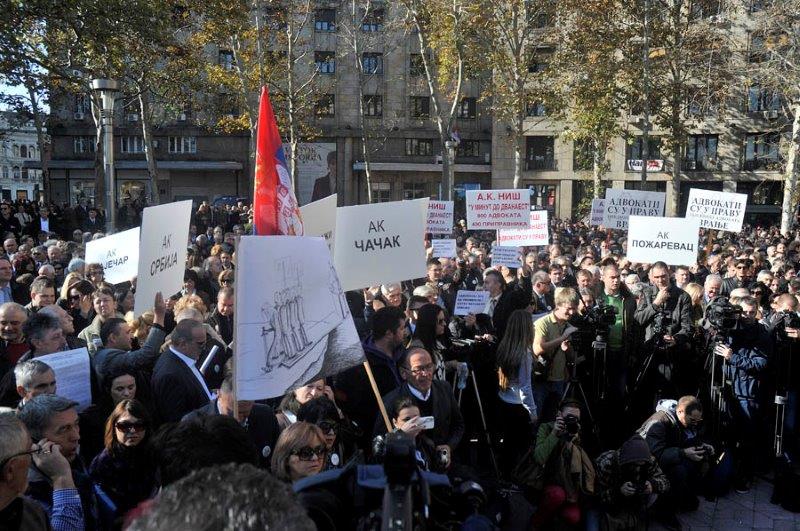
These days there are many more Serbian lawyers in the street than in court.
[Editor’s Note: Serbian criminal defense lawyer Zach Kuvizić writes about recent legislation in his country, essentially granting notaries the right to practice law without a license. Kuvizić, and virtually all his colleagues, regard the law as an assault upon the Serbian Constitution, and have been on strike for two months, with devastating consequences for criminal defendants left without representation. Inmates are stuck in jail, hundreds of trials are postponed, more than 100,000 court hearings canceled.]
Dear colleagues,
I am writing to inform you about Serbian Bar Association struggle aimed at preservation of the profession in Serbia and human dignity of its members. The Association was founded on February 28, 1862 and shared the destiny of Serbian people ever since by honorably serving their legal needs throughout good and hard times equally. Unfortunately, these days the survival of the whole profession in Serbia is in jeopardy. The protest goes on, the justice system is at the standstill because the Bar members do not attend court and other proceedings. As a result, our clients and families suffer, along with people who have been arrested during the last six weeks but did not receive advice from a qualified defense lawyers in order to protect their constitutional rights.
Members of the Serbian Bar Association, including local associations, started protests against the unconstitutional Law on Notary Public which came into effect on September 1st 2014, granting the EXCLUSIVE RIGHTS TO NOTARIES to draft and execute legally binding contracts/agreements and notary deeds in the areas of real estate sales, proprietary interest between spouses and domestic partners, child and spousal support and number of other matters concerning proprietary rights dispositions during lifetime and mortis causa. The powers given to Serbian notaries are unheard and represent a direct attack on our professional integrity and survival because a tremendous part of the legal work traditionally performed by advocates (attorney, solicitor, barrister, Rechtsanwalt, abogado, avvocato, advokat, avocat, δικηγόρος, advocaat or whatever the name is of this noble profession that we do) has been given to a handful carefully chosen individuals with a Fee Schedule that is 10 times or more higher then what the Bar members’ fees have ever been.
The Serbian Bar Association filed a Constitutional Appeal with the Constitutional Court of Serbia, alleging that the legal framework for notaries is unconstitutional, since many laws and regulations in force in Serbia do not coincide with the new Notary law hastily promulgated through the Serbian Parliament. The court has not yet decided the case. We (and I mean everyone out of 8500 attorneys and law clerks in Serbia) hope for the outcome that will declare the whole affair with notaries unconstitutional and order that the Notary Law is made compliant with the Constitution and other laws of the country. Meanwhile, the president of the Serbian Bar met with the Minister of Justice twice. These meetings did not produce a productive dialog, since the Ministry did not show any honest interest in settling the issue.
YOU AND YOUR ASSOCIATION CAN HELP! Please contact your national Justice Ministry and ask that the inquiry is made with the Serbian Ministry of Justice about the Serbian Bar Protest. You can, also, contact your EU representatives who can, as well, contact the EU office in Serbia and seek information about our protest. You can, and we hope you will, forward this message to your colleagues and friends and ask them to show support for our rightful demands. In doing so, please send a copy to the Serbian Ministry of Justice at kontakt@mpravde.gov.rs so that they know that we are not alone.